
Fungal beta-glucans and health: a review of 34 human trials
Reviewed 34 randomized controlled trials of beta-1,3/1,6-glucans from fungi. Supplementation was well tolerated, and its main reported effect was support for the immune system.
For thousands of years, cultures around the world have relied on functional mushrooms for health and vitality. Today, modern science is confirming what traditional medicine has long known: mushrooms contain powerful bioactive compounds that support wellness, resilience, and healthy aging. At iFungi Wellness, we combine this ancient knowledge with evidence-based science to create high-potency mushroom extracts manufactured in Canada under strict quality standards.

✓ Naturally occurring polysaccharides in mushroom cell walls.
✓ Extensively studied for their immune-modulating properties.
✓ Found in highest concentrations in fruiting body extracts.
✓ Our extracts are third-party verified to contain a minimum of 30% beta-glucans.

✓ Bioactive compounds concentrated in Reishi and Turkey Tail.
✓ Contribute to the mushroom's adaptogenic qualities.
✓ Help the body manage stress and maintain balance.
✓ Associated with liver support and antioxidant activity.

✓ Unique compounds found in Lion's Mane mushroom.
✓ Hericenones are studied for their role in nerve growth factor (NGF) synthesis.
✓ Ergothioneine is a potent antioxidant that protects cells from oxidative stress.
✓ Supports brain health, memory, and focus.
Functional mushrooms have been studied for decades for their natural compounds, including beta-glucans, triterpenes, ergothioneine and hericenones. The research ranges from laboratory studies to randomized, placebo-controlled human trials and systematic reviews, and covers immune function, cognitive health, exercise performance and gut health.
Below are peer-reviewed studies on the seven mushrooms in Life Force 7, grouped by mushroom. Each links to its record on PubMed, the U.S. National Library of Medicine's research database.
About this research: These studies look at individual mushroom species, specific extracts, isolated compounds or particular combinations. They are shared for education and are not clinical trials of Life Force 7. The forms, extraction methods and doses studied can differ from those in Life Force 7.
Reviewed 34 randomized controlled trials of beta-1,3/1,6-glucans from fungi. Supplementation was well tolerated, and its main reported effect was support for the immune system.
Explains how mushroom beta-glucans differ from cereal beta-glucans (their 1,6 branching) and reviews research on their immune, anti-inflammatory and metabolic effects, including which areas still need human studies.
Reviews how beta-1,3-glucans with 1,6 side chains, mainly from Shiitake, interact with immune cells, and the signalling pathways involved.
30 adults aged 50 to 80 took about 3 g of Lion's Mane powder or a placebo daily for 16 weeks. Cognitive scores rose in the Lion's Mane group, then fell back 4 weeks after they stopped taking it.
A 12-week randomized, placebo-controlled trial of supplements made from Lion's Mane fruiting body. Scores on one of the three cognitive tests used (the MMSE) improved compared with placebo.
41 healthy adults aged 18 to 45 took 1.8 g of Lion's Mane or a placebo. They were faster on an attention task 60 minutes after a single dose, with a trend toward lower stress after 28 days. A small pilot study; larger trials are needed.
30 women ate cookies containing Lion's Mane or placebo cookies for 4 weeks. Scores on standard questionnaires for low mood and anxiety fell in the Lion's Mane group.
Among 663 adults aged 60 and over in Singapore, those who ate more than two portions of mushrooms a week had less than half the odds of mild cognitive impairment of those who ate less than one. This shows an association, not cause and effect.
A one-year pilot trial in 19 adults aged 60 and over with mild cognitive impairment. Those taking ergothioneine did better on a learning and memory test than the placebo group, with no safety concerns.
Healthy adults aged 18 to 55 took Reishi beta-1,3/1,6-glucan or a placebo daily for 84 days. The Reishi group had higher T-cell and natural killer (NK) cell counts, higher IgA and greater NK-cell activity, with no safety concerns.
Combined 17 randomized trials with 971 participants. Reishi was linked to modest changes in some markers, such as higher levels of the antioxidant enzyme glutathione peroxidase, but the authors rated the certainty of the evidence as very low.
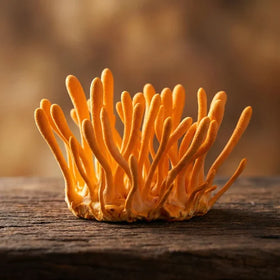
79 healthy men took 1.5 g of Cordyceps militaris or a placebo daily for 4 weeks. The Cordyceps group showed greater NK-cell activity and lymphocyte proliferation, with no adverse reactions.
In a small trial, healthy men and women drank a fermented Cordyceps militaris beverage or a placebo for 8 weeks. NK-cell activity increased and some inflammatory markers (IL-1β, IL-6) decreased, with no safety concerns.
20 healthy older adults took Cordyceps (Cs-4, 1 g a day) or a placebo for 12 weeks. The Cordyceps group improved two exercise thresholds by about 9 to 10%; maximum oxygen uptake did not change.
28 young adults took 4 g a day of a mushroom blend containing Cordyceps militaris or a placebo. After 3 weeks, time to exhaustion and maximum oxygen uptake (VO₂max) improved in the mushroom group.
Most other Turkey Tail clinical research uses specific extracts (PSK and PSP) given alongside conventional medical treatment, so it isn't listed here.
24 healthy volunteers were randomized to Turkey Tail polysaccharopeptide (PSP), an antibiotic or no treatment. PSP produced clear, consistent changes in gut bacteria, in line with a prebiotic effect.
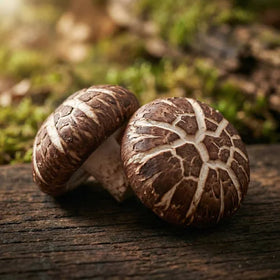
52 healthy adults aged 21 to 41 ate 5 or 10 g of dried Shiitake daily for 4 weeks. Their γδ-T and NK-T immune cells multiplied more readily, salivary IgA rose, and C-reactive protein, a marker of inflammation, fell.
52 adults with mildly raised cholesterol took a Shiitake extract providing 3.5 g of beta-glucans a day, or a placebo, for 8 weeks. Gut bacteria shifted in the Shiitake group; cholesterol and immune markers did not change.
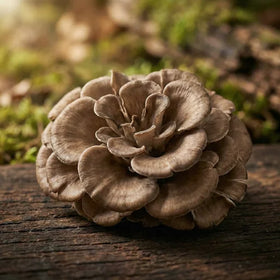
Healthy young and middle-aged to older adults ate bread containing Maitake or a placebo daily for 11 to 18 weeks. The number of colds did not differ, but one Maitake strain was linked to fewer days of fever and runny nose, and to stronger antiviral immune signals in the older group.
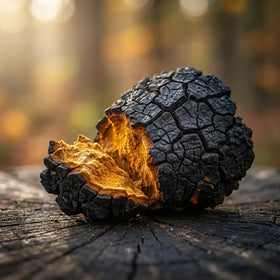
Human research on Chaga is still limited. Most of the evidence comes from laboratory and animal studies, so we list a scientific review rather than clinical trials.
Reviews Chaga's polysaccharides, triterpenoids and polyphenols and their antioxidant and anti-inflammatory activity, drawing mostly on laboratory and animal research.
Laboratory research suggests some mushroom combinations may work synergistically. More human research is needed to know how this applies to multi-mushroom supplements.
Researchers tested Reishi, Shiitake and Maitake extracts on their own and combined, in human immune cells (macrophages). The combination showed a synergistic effect on most of the immune signals measured.
Hover over any mushroom to learn more, and click to stick.
Tap any mushroom to learn more about its unique compounds.

Focus & Memory

Calm & Sleep
Immunity & Antioxidants
Energy & Stamina

Gut Health
Heart & Skin Health
Blood Sugar Support
When you choose iFungi Wellness, you're choosing supplements backed by:
✓ 1,000+ published studies on functional mushrooms.
✓ Certified organic fruiting bodies only in Life Force 7.
✓ Made in Canada in Health Canada licensed, GMP-compliant facilities.
✓ Third-party lab testing for purity and potency.
Science isn't just our foundation—it's our promise.
Disclaimer: This information is for educational purposes only and has not been evaluated by the FDA or Health Canada. These products are not intended to diagnose, treat, cure, or prevent any disease.
Ready to experience the power of functional mushrooms?